Most enterprises already collect data.
Very few operationalize it.
There’s a significant difference between running predictive models and embedding predictive intelligence into core business workflows. The first produces insight. The second produces competitive advantage.
As discussed in our guide on the role of predictive analytics in modern enterprises, transformation happens only when insights influence decisions at scale. Execution is the real differentiator.
Why Predictive Analytics Alone Is Not Enough
Many organizations have invested in data science teams and AI platforms but still cannot achieve measurable ROI.
The problem lies not in the analytics but in the architecture.
The enterprise architecture gaps that we often encounter are:
- Predictive models not connected to ERP or CRM systems
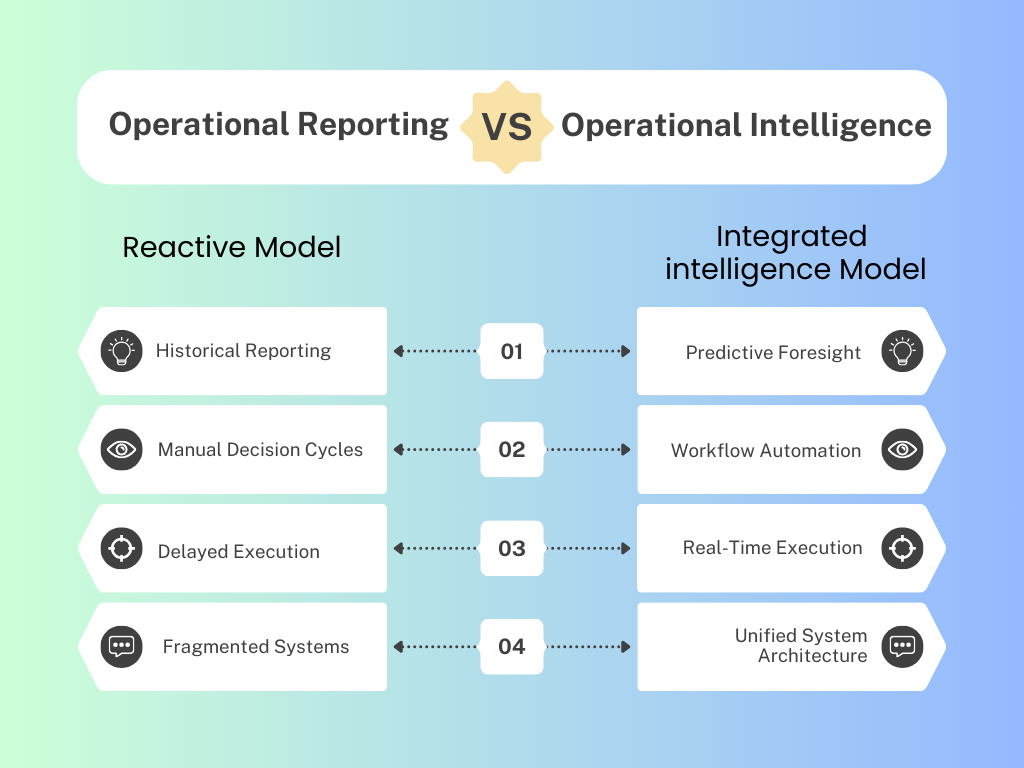
- Batch-based reporting instead of real-time analytics
- Insights without execution triggers
- Fragmented AI tools without a unified integration layer
This is where the importance of an integrated AI platform strategy comes in. Without it, predictive analytics is simply theoretical.
From Forecasting to Automated Decision Intelligence
Real enterprise-grade predictive analytics extends beyond forecasting.
It links prediction engines to operational systems.
For example:
- Churn prediction models activate retention processes in CRM systems
- Demand forecasting models adjust procurement systems in real-time
- Risk prediction engines update credit limits in real-time
- Predictive maintenance alerts activate service processes in real-time
In these examples, the prediction is not in a vacuum.It activates business processes.
This is operational intelligence.
The Architecture Behind Scalable Predictive Systems
If the objective of the application of predictive analytics is the transformation of the entire enterprise, then the following must be part of the predictive analytics architecture:
- Centralized Data Infrastructure
Unified data pipelines for all departments.
- API-Driven System Integration
Seamless integration of all the layers of the analytics stack and business systems.
- Automation Workflows
Triggers for execution must be linked directly to the predictions.
- Continuous Model Monitoring
Retraining pipelines must be part of the architecture to prevent model degradation.
- Governance and Security Controls
This is especially true for industries where regulatory requirements are critical.
This is the main reason why enterprises are moving away from individual AI tools and towards integrated architectures. Predictive analytics cannot be scaled without integration.
High-Impact Use Cases for Enterprise Predictive Analytics
If done correctly, the impact of a well-executed Predictive Analytics project can be felt in the following areas:
Revenue Optimization
Predictive pricing, upsell prediction, and customer lifetime value prediction.
Customer Retention
Churn prediction integrated with automated engagement campaigns.
Supply Chain Forecasting
Demand prediction aligned with procurement automation.
Risk Management
Real-time anomaly prediction aligned with compliance automation.
Asset Performance
Predictive maintenance for reduced downtime and lower operating costs.
What ties all of these together? It’s the trinity of Predictive Modeling, Automation, and System Integration.
This trinity represents the very essence of enterprise execution maturity worldwide.
How Enterprises Should Approach Implementation
A step-wise approach for the implementation of Predictive Analytics for enterprises:
Step 1: Define a Measurable Business Outcome
For example, improve forecast accuracy by 20 percent in two quarters.
Step 2: Audit the Data Architecture
Ensure integration gaps are identified before commencing the development of the model.
Step 3: Start Small – Pilot Project
Focus on a specific business workflow, not the entire organization.
Step 4: Integrate Prediction into Execution Systems
Ensure the output of the prediction model is integrated into the CRM, ERP, or workflow automation tools.
Step 5: Scale Up
Expand the implementation only after a pilot has been validated.
Predictive analytics is not a technology purchase; it’s a systems purchase.
The Real Competitive Advantage
Algorithms are accessible.
Integration depth is not.
Anyone can use machine learning frameworks.
Few can integrate predictive intelligence into operations with architectural cohesion.
That layer of execution is what becomes the long-term competitive advantage.
Organizations that invest in predictive analytics as an infrastructure, rather than an experiment, consistently outperform those who invest in predictive analytics as a reporting upgrade.
Final Perspective
Predictive analytics in business is not about seeing into the future.
Predictive analytics in business is about eliminating uncertainty in critical decisions.
When predictive intelligence is integrated into the enterprise, the organization moves from reactive management to proactive control.
This effect compounds over time.
FREQUENTLY ASKED QUESTIONS
-
What is enterprise predictive analytics?
Enterprise predictive analytics is the process of using historical data and machine learning models to predict business outcomes and integrate these predictions with business systems to make better business decisions.
-
How is predictive analytics different from business intelligence?
Predictive analytics is different from business intelligence in that business intelligence uses historical data to make better business decisions, while predictive analytics uses historical data to predict business outcomes in the future.
-
How do enterprises implement predictive analytics successfully?
Enterprises can implement predictive analytics successfully using centralized data infrastructure, system integration, automation workflows, model monitoring, and measurable business outcomes.
-
What are the industries that benefit the most from using predictive analytics?
The industries that benefit the most from using predictive analytics include finance, healthcare, manufacturing, retail, and logistics.
-
Why does predictive analytics fail in many organizations?
Predictive analytics fails in many organizations because of disconnected systems, poor data quality, a lack of system integration, a lack of clear objectives, and a lack of automation layers.