- September 9, 2026




Making a minimum viable product goes beyond selecting features and hiring developers. One of the very first things a startup company needs to decide is what kind of scope management they need.
Do they need to define all the features and deliverables before the process of development even starts?
Do they need to have some sort of flexibility within the product that allows them to change things up as they learn more?
This is what distinguishes fixed-scope MVP from flexible-scope MVP. Neither option is better by default.
What Is a Fixed-Scope MVP?
A fixed-scope MVP is developed around a predefined set of features, deliverables, timelines and costs. Before development starts, the team agrees on what will be built and what will remain outside the initial release.
For example, a booking-platform MVP might include:
- User registration
- Service listings
- Appointment scheduling
- Online payments
- A basic admin dashboard
Features such as loyalty programmes, advanced analytics and multiple payment providers may be valuable, but they are intentionally reserved for later versions.
This structure gives the startup a clear path from planning to launch. It also makes the MVP development cost and timeline easier to estimate.
What Is a Flexible-Scope MVP?
A flexible scope MVP means that features, priorities, or even workflow can vary throughout the process of product development. Rather than committing to one feature list from the very beginning, the product is constantly evolving as the team learns more about it.
This approach may work well for a startup that tries out an unknown market, tests out a new technology, or works with early adopters that may strongly influence the product’s evolution.
But there should still be some limits. Without a launch goal and a decision making process, the flexible MVP can easily evolve into a larger product with an uncertain budget and release date.
Fixed-Scope vs Flexible-Scope MVP: Key Differences
The main difference is not simply whether changes are allowed. It is how uncertainty is managed.
A fixed-scope MVP controls uncertainty by making decisions before development. A flexible-scope MVP manages uncertainty by allowing decisions to evolve during the project.
Area | Fixed-scope MVP | Flexible-scope MVP |
Features | Agreed before development | Can change during development |
Budget | More predictable | May increase as priorities change |
Timeline | Easier to protect | Can shift with the scope |
Planning | Detailed upfront | Continuous throughout the build |
Best suited for | Clearly defined product ideas | Products with important unknowns |
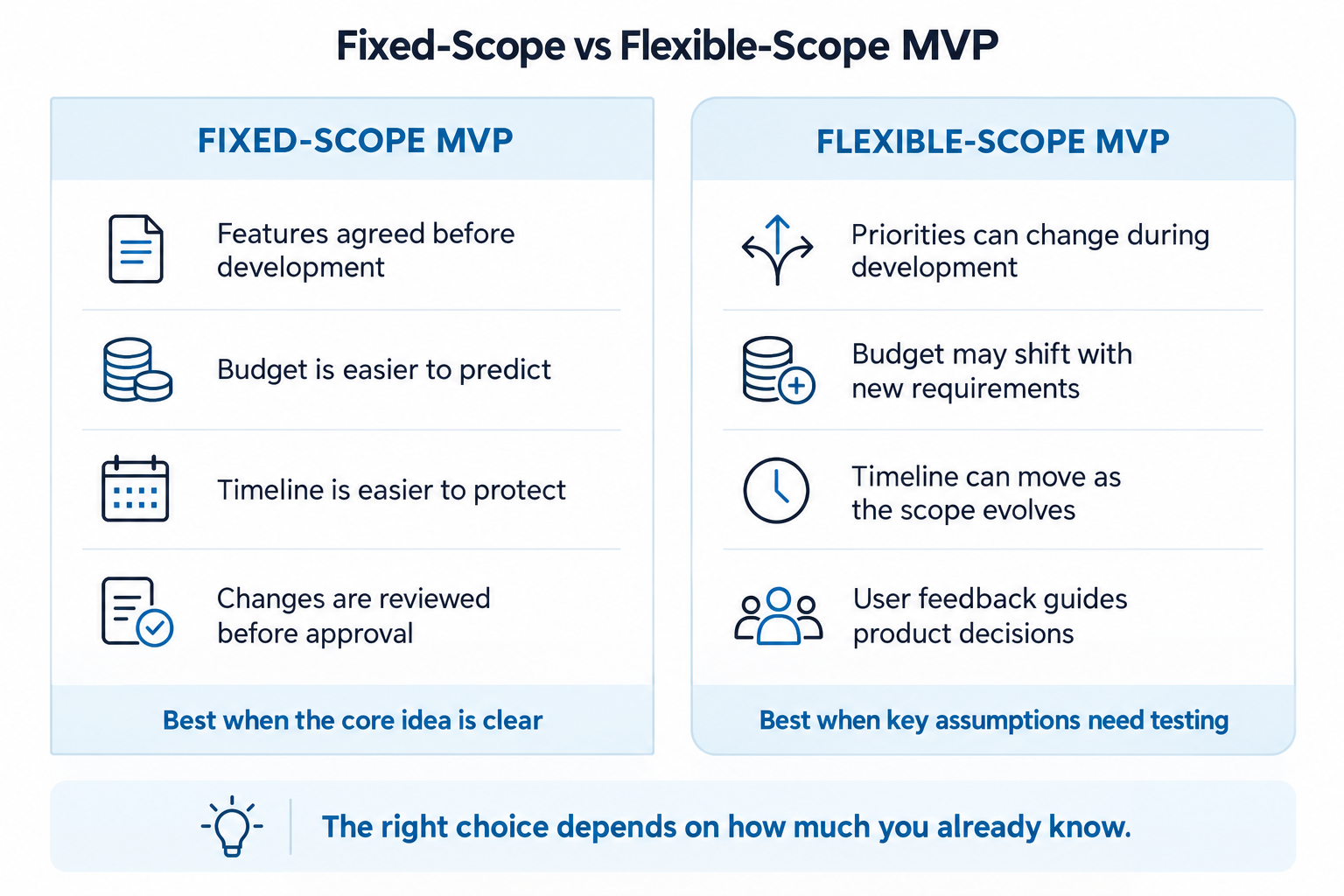
For many startups, predictability is valuable. However, rigidly following an early plan can also be risky if new evidence shows that an important assumption is incorrect.
Benefits of a Fixed-Scope MVP
The strongest advantage of a fixed scope is clarity. Founders, designers and developers know what the first release must achieve.
It also helps protect the project from scope creep. During development, new ideas will almost always appear. Some may be useful, but adding each one immediately increases development time, testing requirements and cost.
With a fixed scope, additional ideas are documented for future phases instead of being allowed to interrupt the current launch.
This approach works particularly well when:
- The target user is clearly defined
- The core problem has already been validated
- The main workflow is understood
- The startup has a limited budget
- A specific launch date matters
A fixed scope does not mean the product can never change. It means changes are evaluated carefully rather than added automatically.
Limitations of a Fixed Scope
A fixed-scope approach depends on the quality of the decisions made before development begins. If the original assumptions are weak, the team may build the agreed product successfully but still create something users do not need.
It can also become too restrictive when feedback reveals a genuine problem with the core experience. Refusing every change simply because it was not included in the initial plan can protect the timeline while weakening the product.
For this reason, a fixed scope should protect the launch objective, not prevent sensible decisions.
Benefits and Risks of a Flexible-Scope MVP
Flexible scope gives a startup room to respond to evidence. If user testing shows that a workflow is confusing or a planned feature is unnecessary, the team can adjust its priorities.
This can be valuable for innovative products where the correct solution is not yet obvious.
The risk is that every idea can begin to feel urgent. A founder requests one additional feature, early users suggest another, and developers discover new possibilities. The MVP grows while the launch keeps moving further away.
Flexible scope can also make budgeting difficult. A small change to the interface may affect development, integrations, testing and deployment. Several “small” changes can create a substantial increase in cost.
Flexibility works best when the team has a fixed budget or timeline, clear priorities and a disciplined process for approving changes.
Which Approach Should Your Startup Choose?
Choose a fixed-scope MVP when you understand the user, the problem and the main product journey. It is usually the safer choice when your priority is launching within a controlled budget and timeframe.
Choose a flexible-scope MVP when the product contains important uncertainties that can only be resolved through testing. In this case, the team should expect some features to be replaced, reduced or removed as learning takes place.
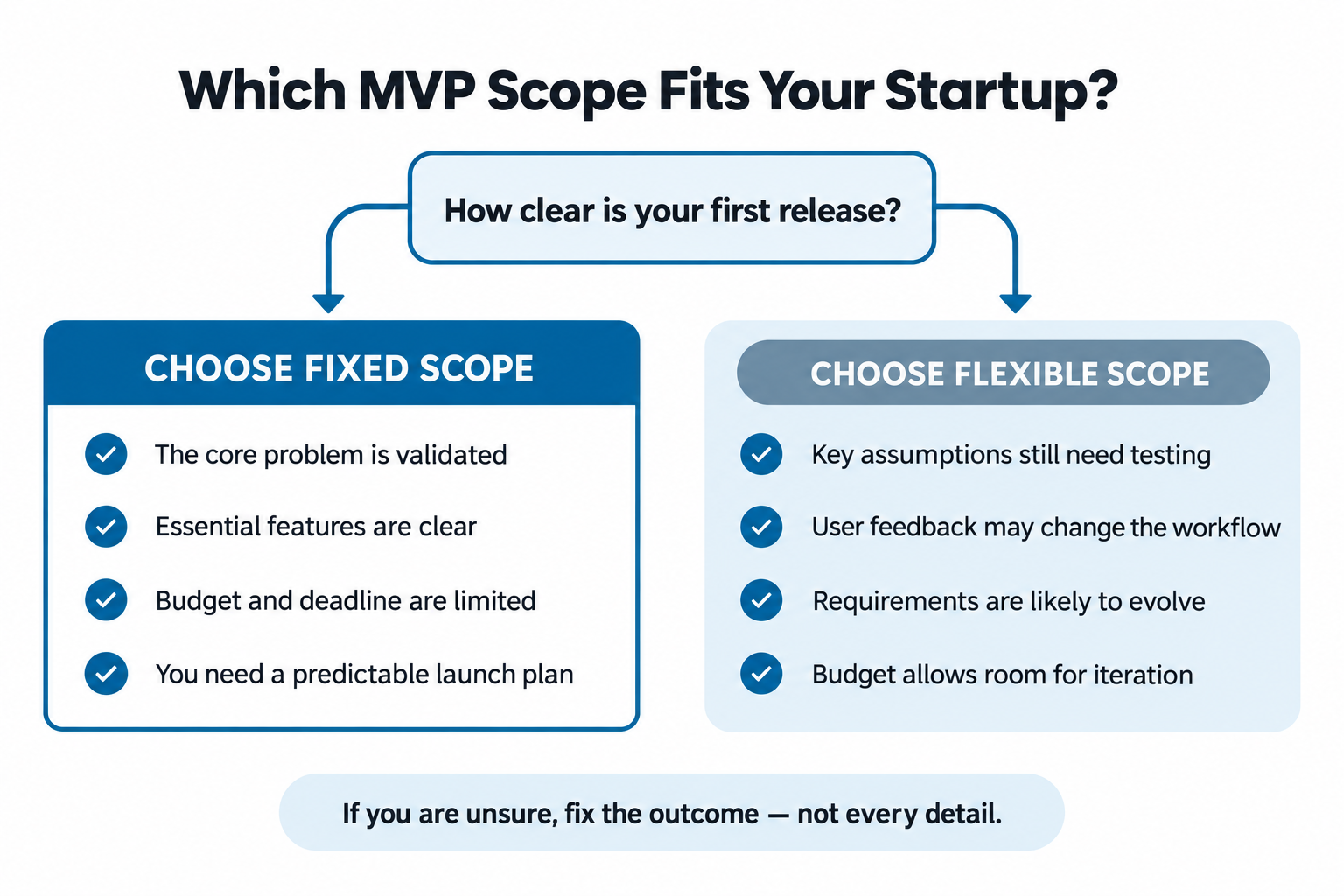
If you are still debating dozens of possible features, flexibility may not be the immediate answer. You may first need a product discovery phase to identify the smallest version capable of testing your most important assumption.
A Better Option: Fixed Outcome, Controlled Flexibility
For many startups, the most practical approach sits between the two models.
The launch objective, core workflow, budget and timeline remain fixed. Flexibility is allowed within those boundaries when a change directly improves validation or removes a serious usability problem.
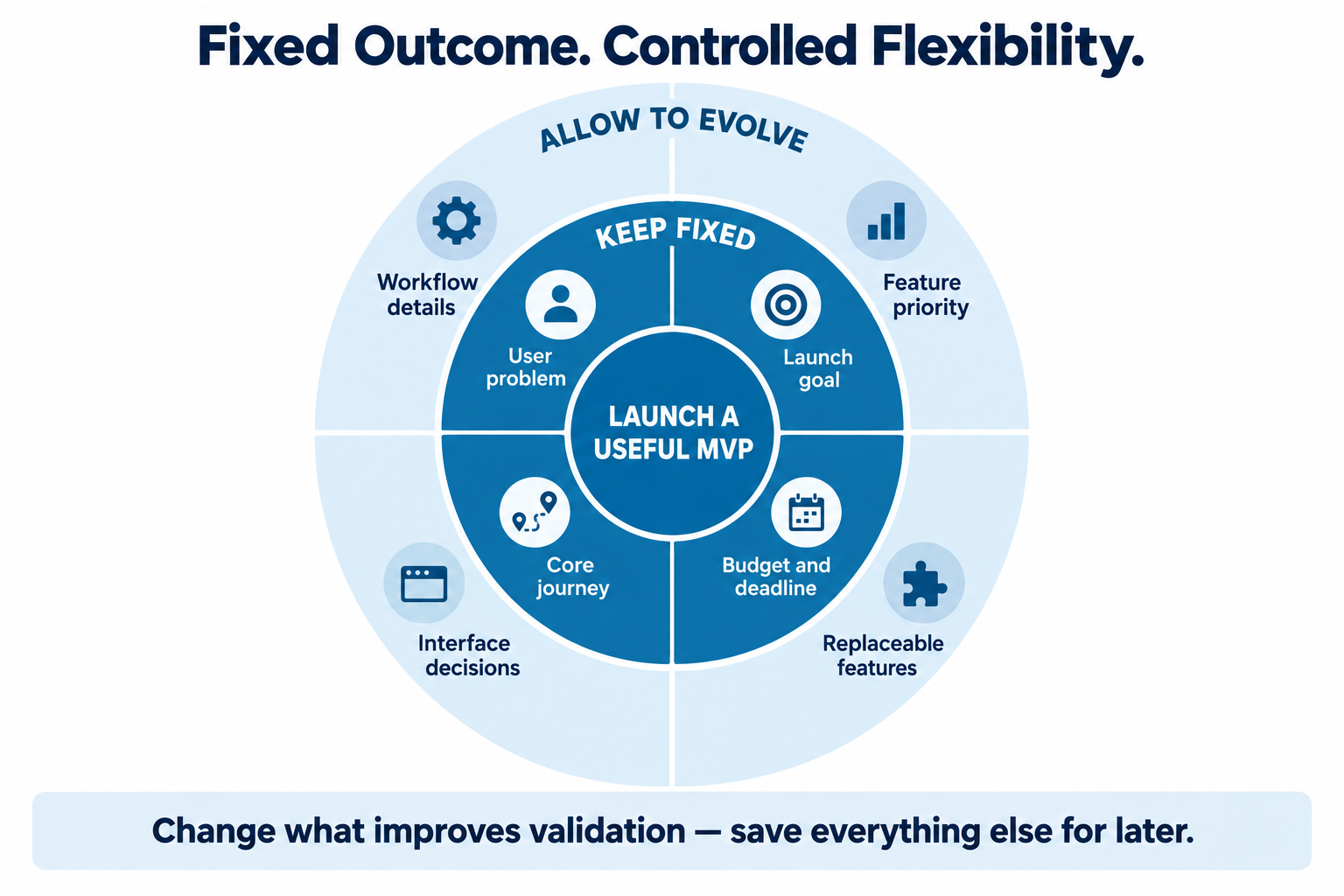
For example, the team might replace an ineffective onboarding flow without adding an unrelated reporting feature. One supports the purpose of the MVP; the other expands its scope.
This approach gives startups space to learn without turning development into an open-ended project.
At AppCatalyser, we believe an MVP should create evidence, not attempt to become the final product. Defining the outcome first, protecting the essential scope and moving non-essential ideas into later phases helps teams launch in weeks rather than months.
Final Thoughts
So, which option is better?
If you already know who the product is for and what the first version needs to prove, fixed scope is usually the more practical choice. It keeps the build from growing every time a new idea comes up.
But not everything will be clear from day one. Sometimes early feedback shows that a workflow needs to change. That is fine. The scope should leave enough room for useful changes without allowing the MVP to turn into a much bigger product.
This is something we help founders work through at AppCatalyser. Before development starts, we look at the idea, question what is actually needed and separate launch essentials from features that can wait. It makes the first build easier to manage and gives the product a better chance of reaching users sooner.
Not sure what to include in your MVP? Share your idea with AppCatalyser, and we’ll help you make sense of the first version.
Frequently Asked Questions
Is a fixed-scope MVP cheaper to build?
In most cases, it is easier to budget for. You know what is being built before the work starts. Costs usually rise when new features are added halfway through development or an unexpected technical problem comes up.
Can the scope change once MVP development has started?
It can. Say early testing shows that the onboarding process is confusing. Changing it may be worth the extra work. But adding a feature simply because it would be “nice to have” is a different matter and can usually wait.
Why does MVP scope creep happen?
A new idea comes up during a meeting and sounds small enough to include. Then the same thing happens again the following week. Before long, the team is building far more than planned, but the original budget and launch date have not changed.
Should an early-stage startup choose a fixed or flexible scope?
If you know the problem you’re solving and what users need to do, start with a fixed-scope MVP. If you’re still testing how the product should work, leave some room to adjust it. Just don’t treat “flexible” as permission to keep adding features.
What features should be included in an MVP?
Only the features needed to complete the product’s main job. A booking app, for example, needs a way to choose a service, select a time and confirm the booking. Reviews, rewards and detailed reports may be useful later, but the first version can work without them.