- September 9, 2026




A new product idea rarely feels small.
Once planning begins, more features start appearing. User profiles need additional settings. The dashboard needs more reports. One integration turns into four. Before long, the “first version” starts looking like a complete platform.
This is where MVP development becomes valuable.
A minimum viable product is not simply a smaller version of the final software. It is a focused product designed to test whether one important idea works for real users. Its purpose is to create evidence before a business invests in wider functionality.
The difficult part is not developing the MVP. It is deciding what deserves to be developed first.
What Is the Main Purpose of MVP?
The main purpose of MVP is to validate the core value of the product with real users without making its scope too large initially.
This kind of validation can come down to different questions:
- Is the user going to perform the desired action?
- Is there any problem solved by the product that is important for him/her?
- Is he/she ready to return, to be a subscriber or to pay?
- Is the suggested workflow working properly?
- Which one of the things needs improvement?
An MVP should focus on answering one question primarily.
When a product tries to validate the audience, the business model, the interface, the advanced technology and many other aspects at once, the outcome becomes hard to understand.
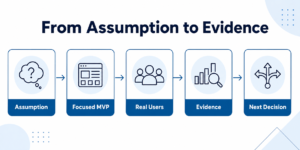
Start With the User Outcome, Not the Feature Set
One common starting point for software planning is: “What features do we need?”
The real question is “What is the user going to be able to do?”
Imagine a wellness application online. One of its first milestones could be enabling users to schedule and successfully complete a virtual consultation.
This milestone will probably need registration, practitioner discovery, scheduling, payments, and video conferencing.
Community support, device integration, analytics, and personalized content could make the platform better later on. But they aren’t essential for testing the virtual consultation process.
Such an approach enables startups to understand whether the feature is adding value or just making the product more “whole.”
Filters to Determine MVP Scope
Any feature being considered for the MVP scope has to pass through three filters before inclusion into the MVP.
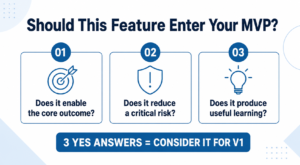
1. Is It Critical for Delivering the Core Outcome?
Any feature that is required to achieve the core outcome must be included in the MVP scope.
In other words, if removal of a certain feature stops working the core workflow of the product, then it must be critical to achieve the main outcome. Otherwise, it can be planned for post-launch release.
2. Does It Mitigate Critical Risk?
There may be certain features that are not obvious for a user but must be there because of some specific reasons.
For instance, features such as access control, encryption, consent management, secure payments, logging and audit, and regulation-specific features must be there if they provide any protection for the business or the product.
Certain types of products must consider HIPAA, GDPR, and PCI DSS right from the beginning.
Some things cannot be added to the product safely after launch.
3. Will It Help the Team Learn Something Useful?
Features that will provide knowledge required for the next product decision deserve to be in the MVP scope.
For example, simple tracking can give a clue if users completed onboarding, stopped a workflow or came back after their first visit. This information is more valuable than collecting a bunch of data with no specific decision attached to it.
What Should Stay Out of the First Release?
Features often enter an MVP because they sound valuable, not because they are immediately necessary.
The following items usually deserve closer scrutiny:
- Multiple versions of the same workflow
- Extensive profile customisation
- Advanced reporting dashboards
- Integrations without confirmed user demand
- Automation for low-volume processes
- Secondary user roles
- Complex admin controls
- Visual effects that do not improve usability
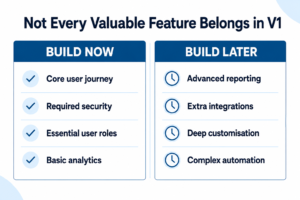
This does not mean these features are unimportant. It means their timing should be justified.
A useful product roadmap records what comes later without allowing future ideas to interrupt the current build. This gives founders room to think beyond the MVP while keeping development focused.
Build One Full Journey
Limiting scope does not mean reducing the app’s capability to provide a complete experience.
For instance, an app such as a patient portal that enables users to sign up but can’t show their records and doesn’t allow them to connect with the doctor is not providing any value to them. Likewise, an online shopping site that shows items for sale but fails to complete a purchase process is testing only part of the buying journey.
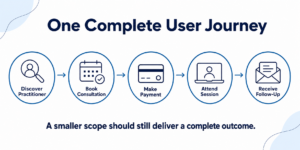
A proper MVP must link all the important steps in a journey starting from the initial phase to the end result.
This journey must be:
- Intuitive
- Reliable
- Secured where necessary
- Measurable
- Real-world viable
Reducing scope should remove distractions not break the experience.
Plan for Change While Not Overbuilding from Day One
Fearing that a minimal product may restrict their ability to scale in the future, founders tend to overbuild.
Overbuilding is not the solution; rather, the key is making architectural choices that provide space for future changes.
Scalable MVP architecture may be characterized by such things as a properly designed database, well-documented APIs, user authorization/permissions, modular structure, and proper cloud infrastructure.
Such architectural choices can facilitate future developments while avoiding any additional functionality in the early build.
The task is finding a balance between not creating conditions for the immediate reconstruction and developing for millions of people prematurely.
Measure Behaviour After the MVP Launch
Launching the product is the beginning of validation, not the end of development.
The team should decide in advance which user actions will indicate progress. Depending on the product, relevant MVP metrics may include:
- Account activation
- Completion of the core workflow
- Repeat usage
- Trial-to-paid conversion
- User retention
- Support requests
- Abandonment points
Numbers show where something is happening. User interviews, support conversations, and usability sessions help explain why.
In combination, these observations will help identify whether it is time to modify the workflow, rethink the product positioning, add some more features, or question certain assumptions.
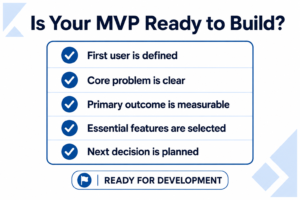
When Is an MVP Ready to Build?
An MVP is ready for development when the team can clearly explain:
- Who the first user is
- Which problem the product addresses
- What outcome the user should achieve
- Which features are necessary for that outcome
- What evidence will determine the next decision
If these answers remain unclear, starting development may only turn uncertainty into unnecessary complexity.
How App Catalyser Helps You Build the Right MVP
App Catalyser helps you get your startup idea ready to create an MVP. Our process starts with establishing the key end goal for the users, picking the necessary features to validate the idea, and simplifying the first release. The whole process from UX and workflow design to development, testing, and launch of the app is based on a proven methodology, so that you can go from idea to MVP within weeks.
Whatever you need to either improve an already developed idea or prepare to develop the first version of your product App Catalyser can provide you with the technical expertise and structure for your project.
Ready to define your MVP scope? Let’s discuss your idea.
Final Takeaway
Successful MVP development begins with disciplined decision-making.
The first release does not need to represent the entire product vision. It needs to solve one real problem through one complete journey and provide enough evidence to guide what happens next.
Build what is necessary to learn. Let actual user behaviour shape the rest.
Frequently Asked Questions
How many features should there be in an MVP?
No magic number here. An MVP must contain the minimal number of features required to achieve and measure a single user goal.
Is an MVP supposed to be scalable?
It needs a stable foundation and an approach to future development. It doesn’t have to include any infrastructural components that could handle unverified demand.
Can additional features be added throughout the development of the MVP?
Yes, but only those needed to solve critical requirements or misunderstandings. Constantly adding them will undermine the initial goal of validation.
What follows the launch of an MVP?
The team analyses user behaviour, obtains their feedback, removes any friction and makes a decision on what improvements have solid backing.
How do you decide which features belong in an MVP?
Think of the most important result that a particular product brings to its users. Include in your MVP features that are necessary for accomplishing that result, dealing with high risks, or getting validation data.
Previous Article

August 19, 2026
7 MVP Mistakes We Made Early On and the Lessons We Still Apply Today
Next Article
August 19, 2026
Fixed-scope vs. Flexible-scope MVP – What’s Right for Your Startup?