Building a startup app doesn’t have to take 6–12 months.
In fact, for early-stage founders, taking that long can be dangerous. Markets shift. Competitors move. Budgets shrink. And by the time the product launches, the opportunity may already be gone.
The smarter approach?
Launch fast. Learn fast. Improve fast.
Here’s how you go from idea to live users in 21 days — and more importantly, what you build and what you intentionally cut.
Why Most Startup Apps Take Too Long to Launch
Let’s face it: most of these delays are not tech-related.
They occur because startup founders tend to fall into three pitfalls:
1. The Perfection Trap
Perfecting the UI before even validating the idea.
Adding animations before validating demand.
2. Feature Creep
Adding “just one more feature” un
til the product is bloated.
3. Lack of Clear Prioritization
Building based on excitement, not strategy.
The consequence? Months of development with no actual users.
An Overview of the 21-Day Launch Methodology
The 21-Day launch is about focus (not speed).
The most important principle of the 21-Day Launch is that you create for the purpose of learning (not for the purpose of perfecting).
Your first version is a validation tool; it is not intended to be the final version.
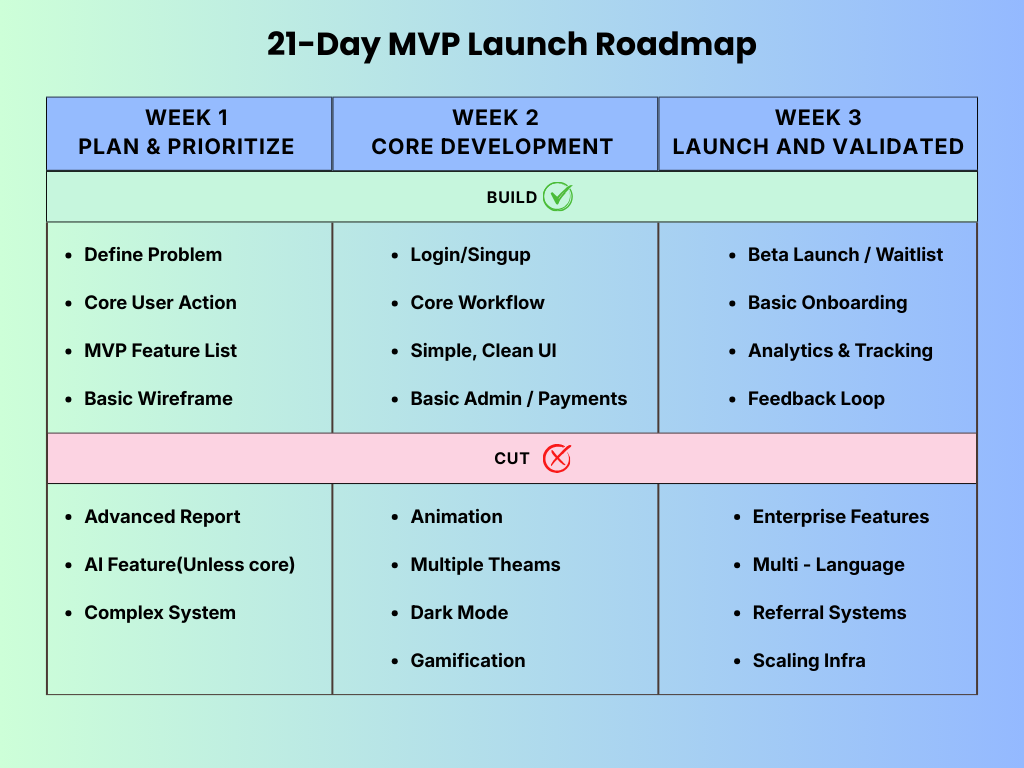
Week 1 – Defining the Problem, Validating it, and Prioritizing Features
Week one is a week to think, not to code.
What Gets Built
- The problem clearly states (one sentence only) what you will build.
- Define your audience.
- The core value proposition of what you build.
- A basic wireframe outline (without design).
- A list of MVP features (what you must build or would like to build).
The only question that needs to be answered is;
what is the one core action the user has to take to accomplish their goal.
The one core action becomes the focus of your MVP.
What Gets Cut
- Advanced reports.
- AI integration (unless it is absolutely required for success).
- Complex auto-scheduling.
- Multi-user systems.
If an item does not directly support the core problem, you will not address it; you will address it at another time.
Week 2 – Only the Core Engine Development Starts
Now, Let’s Start Development But Only On the Core Engine.
What Gets Built
- Login/Signup
- Core Functionality (core workflow only)
- Simple, Clean User Interface
- Payment Integration
- FEW Extras Alternatively For Payment
- Administrative Access
This phase is not intended to WOW user.
It’s Designed To Empower User.
What Gets Cut
- Custom Animations
- Multiple Themes
- Dark Mode
- Gamification
- Analytics
Remember:.
Functional > Fancy
Week 3 – Launch, Test & Get Real Users
The goal is not a “big launch.”
The goal is live feedback.
What Gets Built
- Simple landing page
- Beta access or waitlist
- Basic onboarding
- Analytics tracking
- Feedback loop system
You now have something usable.
What Gets Cut
- Enterprise-level features
- Multi-language support
- Referral systems
- Scaling infrastructure
Those come later — when real users justify them.
What “Good Enough” Really Means
Many founders struggle with this.
Good enough means:
- It solves one clear problem
- A user can use it without instructions
- You can collect data from it
- You can improve it quickly
It does not mean incomplete.
It means focused.
The 80/20 Rule in Startup Development
In most startup apps:
- 20% of features deliver 80% of value
- The rest are distractions
Your job in 21 days is to identify that critical 20%.
The faster you launch, the faster you learn.
And the faster you learn, the faster you win.
Common Mistakes Founders Make During Rapid Launch
Even when trying to move fast, founders make mistakes:
- Building for investors instead of users
- Overestimating feature demand
- Delaying launch for “one more improvement”
Every delay increases cost.
Every week without users is lost insight.
The Power of Early Live Users
When real users start interacting with your app, everything changes.
You get:
- Real validation
- Clear product-market signals
- Honest feedback
- Retention insights
- Revenue testing opportunities
This is when growth becomes strategic — not hypothetical.
Checklist – Are You Ready to Launch in 21 Days?
Before launching, make sure:
- The problem to be solved is well understood
- The key feature is implemented and complete
- Unnecessary features are eliminated
- Analytics is set up
- Beta testers are identified
If yes – launch
How App Catalyser Helps You Launch in 21 Days
Launching in 21 days is not an easy task.
At App Catalyser, we help you with:
- Disciplined sprint development
- Tight feature prioritization methodologies
- Validation before building
- Milestone planning
- Post-launch development support
We don’t build apps.
We help founders resist feature creep and get from idea to actual users quickly.
Conclusion: Speed Is Your Competitive Advantage
Perfection holds back growth.
Speed builds momentum.
If you move fast, you learn fast.
If you learn fast, you improve fast.
And if you improve fast, you beat the competition.
The only question is not:
“Can we build everything?”
The only question is:
“What is the minimum that we need to build to start learning?”
Ready to Launch Your App in 21 Days?
If you are serious about turning your idea into live users without wasting months on unnecessary features, let’s talk.
Book a strategy call with App Catalyser today.
Get clarity on your MVP.
Launch faster than you thought possible.
Your idea doesn’t need more time.
It needs focus.






This was such a clear and comprehensive breakdown of AI, ML, and Deep Learning. As someone working in a non-technical business role, I often find these terms overwhelming and interchangeable. The analogy of AI being the overall goal, ML as the method, and DL as the advanced tool really helped solidify my understanding.
Thanks!