Every startup has a huge vision. Several features, smooth UI, perhaps even a mobile app. And then comes reality – budget and time.
One of the most frequent founder questions in today’s world is:
“What can I realistically build in 30 days with a lean, early-stage MVP budget?”
The truth is simple: enough to validate your idea, but not enough to build a full product.
And that’s exactly what an MVP is meant to do.
A low-budget MVP is not something meant to wow investors with its polish.
It’s meant to get a functional version in front of actual users, learn what works, and iterate from there.
Let’s take a look at what you can realistically build.
What a Lean MVP Budget Really Means
At this early MVP stage, your product has to remain lean.
You’re not building a feature-rich platform. You’re building a functional first version that validates one thing: people actually want what you’re offering.
This stage typically supports:
- One problem solved well
- A simple interface
- A basic user journey from start to finish
- Limited integrations
- Early user testing
It will not support advanced systems, heavy automation, or complex design at this validation stage.
What Can Be Built in 30 Days
A 30-day MVP development project is a fast-paced process. This is because you are choosing to focus on less and avoid unnecessary complexity.
This is what can be built in a focused, validation-first startup MVP.
One Core Feature
Your MVP should center around one core action that users come to your application for.
Examples of this include:
- Booking a service
- Submitting a request
- Managing a task
- Accessing a single useful tool
This is not the time to build multiple dashboards, modules, or complex workflows. Instead, focus on building one thing well.
Basic User Accounts
Most early-stage MVPs include basic user account functionality:
- Sign up and login
- Password reset
- Basic profile information
Complex permission systems or multiple user roles are not included at this price point.
Simple, Functional Interface
A simple, functional interface is what you can expect. Designers will use templates or component libraries to keep costs down.
Your application will look professional, but it won’t have custom animations, complex branding, or complex user flows. Instead, focus on making it simple and functional.
One Important Integration
You can include one important integration such as:
- Payment processing
- Email notifications
- A map or location service
Trying to integrate too many external tools at once will quickly blow your budget.
Basic Admin Controls
A simple admin panel can be included to help you manage users, content, or requests. This allows you to operate the product without depending on developers for small changes.
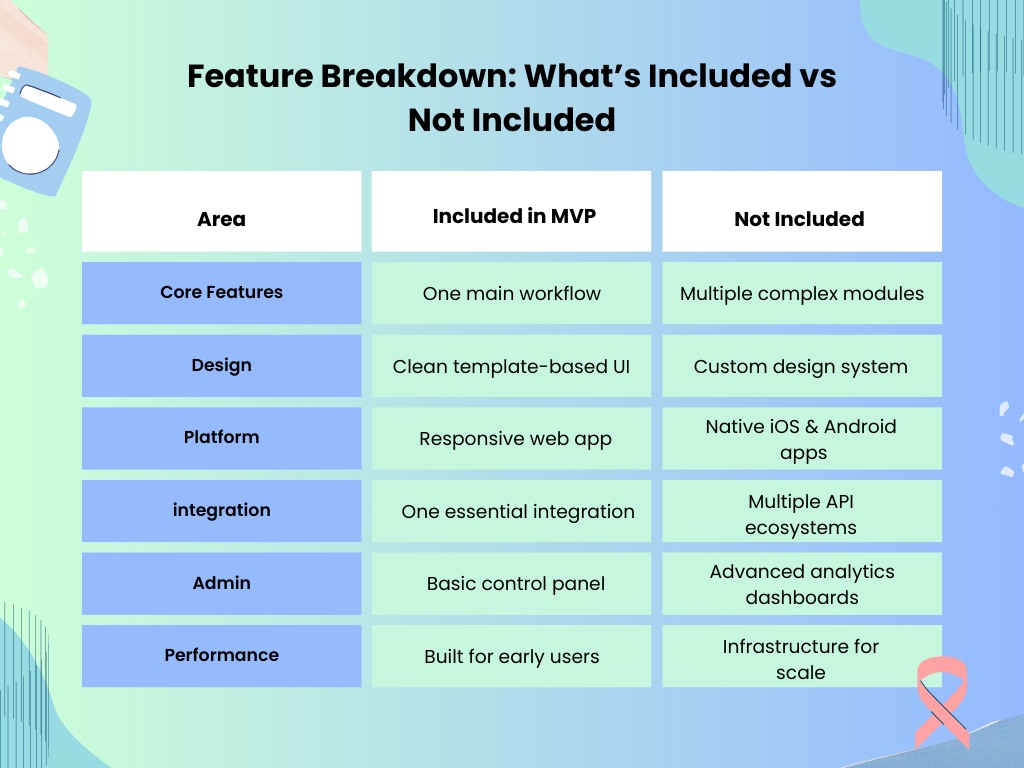
Feature Breakdown: What’s Included vs Not Included
Here’s a clear comparison of what’s included in the MVP and what’s excluded to avoid unnecessary complexity.
What You Cannot Build with This Budget
It is as important to understand what you cannot build as it is to understand what you can build.
A validation-first MVP is not appropriate for:
- Platforms with lots of AI
- Real-time chat or tracking functionality
- Large marketplaces with complex matching logic
- Enterprise dashboards
- Fully custom mobile apps
- Highly interactive or animation-heavy designs
Trying to fit these into a small budget often leads to delays, frustration, and unfinished products.
A Realistic Scenario
Let’s assume that a founder wants to develop a home cleaning services booking platform.
With a constrained MVP scope and a 30-day timeline, the MVP would consist of the following:
- User registration and login
- A list of available service providers
- A booking request form
- Email confirmations
- An admin view to manage bookings
What it would NOT include:
- A mobile app
- Live service tracking
- AI-based matching
- Complex review systems
Even without these components, this MVP is enough to start the user onboarding process.
How the 30 Days Usually Unfold
Rapid progress is achieved through planning. A standard MVP development process for a month may be broken down as follows:
Week 1 – Planning and Scope
Defining product features, user flow design, and wireframing.
Week 2 – Core Build
Building the core product feature and user interface.
Week 3 – Integrations and Admin Setup
Integrating email or payment functionality and admin functionality.
Week 4 – Testing and Launch
Resolving bugs, optimizing usability, and launching the product.
Unforeseen changes in product features during this time can throw off the schedule.
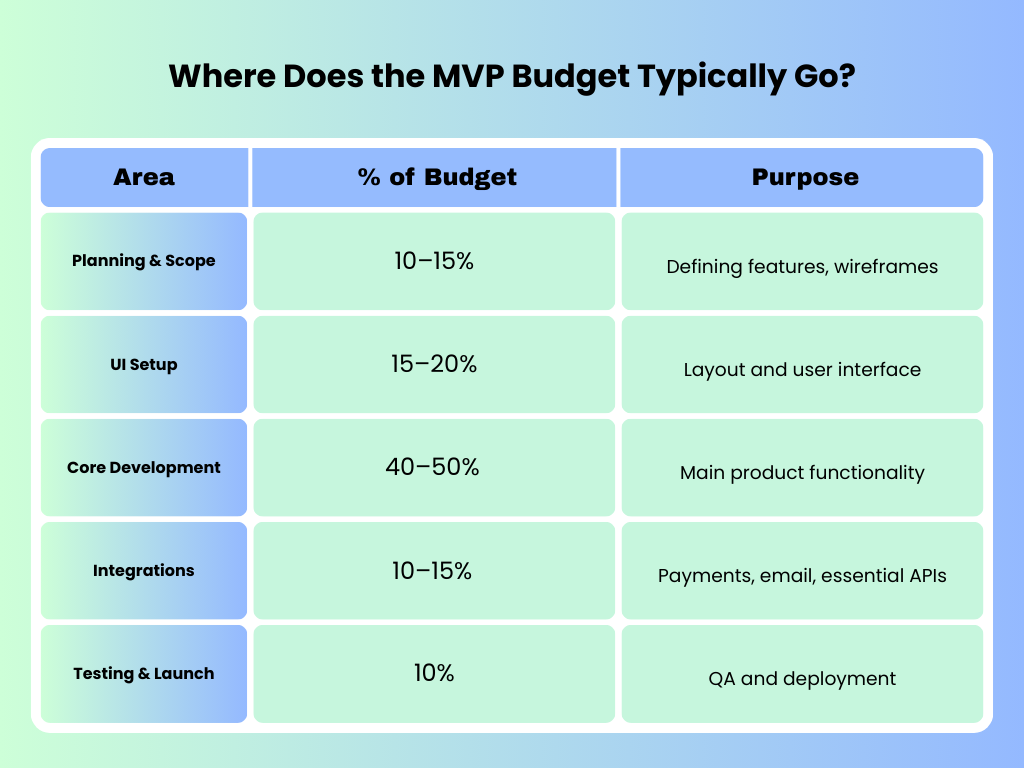
Where Does the MVP Budget Typically Go?
Let’s walk through how a lean MVP budget is typically allocated in a real MVP build.
Final Thoughts
A lean, early-stage MVP developed in 30 days will not resemble a completed startup product — and it shouldn’t.
What it will do is:
- Validate if anyone wants your solution
- Allow you to learn from real users
- Provide you with confidence before you invest more
- Perfection is not the aim. Validation is the aim.
Create something small, launch it fast, and learn from users. This is how great products are created – one focused step at a time.
At AppCatalyser, we assist founders in creating focused MVPs that go live fast – so you can validate before you overinvest.