Most founders don’t struggle with ideas.
They struggle with deciding what not to build.
When you start planning your product, everything feels important. Every feature sounds necessary. But this is exactly where startups lose time, burn budget, and delay launch.
A strong MVP development strategy isn’t about building less.
It’s about building only what proves your idea works.
If you’re serious about launching fast – especially within a focused 30-day timeline – feature prioritization becomes everything.
Let’s break it down properly.
What Is MVP in App Development?
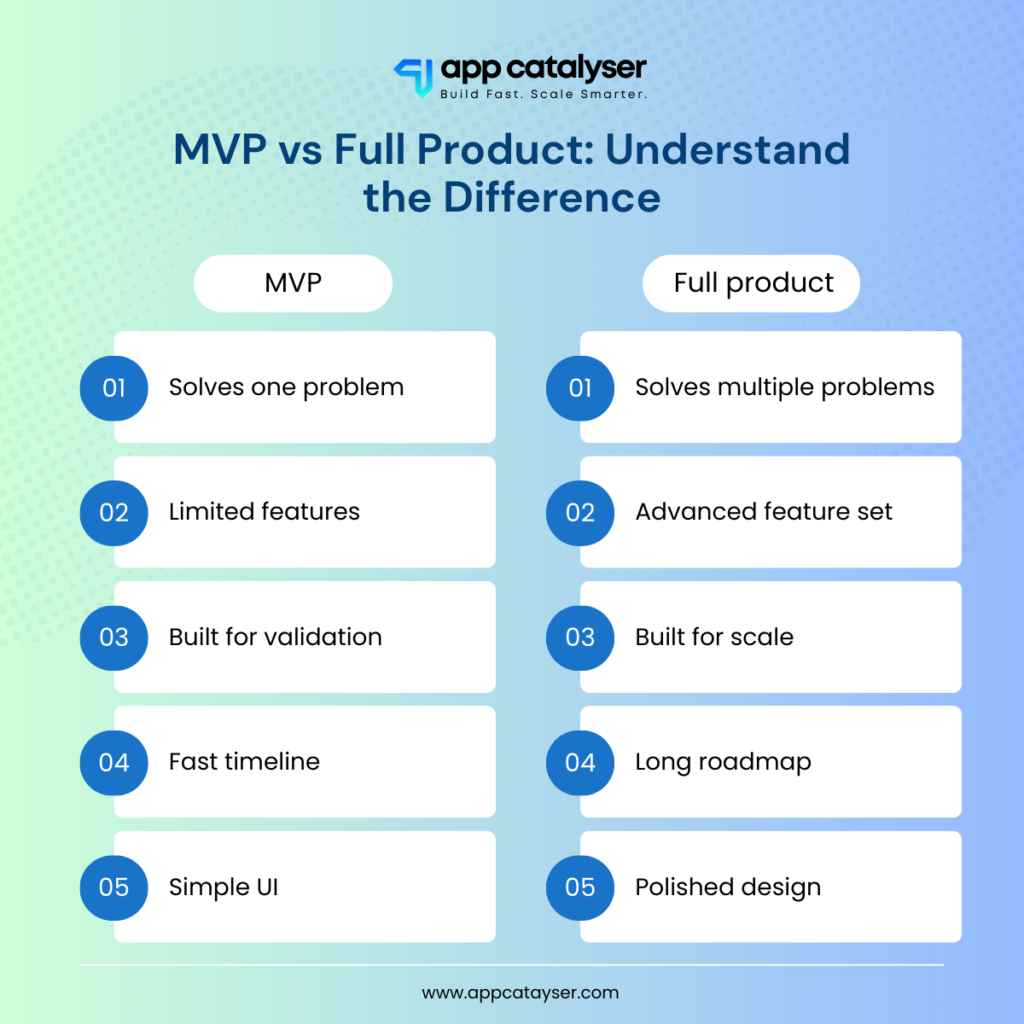
An MVP (Minimum Viable Product) is the simplest working version of your app that solves one core problem for one specific audience.
It is not:
- A half product
- A cheap version
- A demo
It is a validation tool.
The purpose of an MVP in app development is simple:
Launch → Test → Learn → Improve.
Instead of guessing what users want, you let real users tell you
Why Most Founders Overbuild
Here’s what usually happens.
A founder starts with a simple idea.
Then:
- “Let’s add analytics.”
- “Let’s add AI.”
- “Let’s add multi-user roles.”
- “Let’s add advanced dashboards.”
Suddenly, a 4-week product becomes a 4-month project.
Overbuilding happens because there is no structured MVP development process.
Without discipline, feature creep takes over.
The Core Rule of MVP Strategy
Each MVP has to answer one question:
What is the one core action the user has to perform?
Examples:
- Booking a ride
- Scheduling an appointment
- Uploading a document
- Tracking a task
If your app can’t define its core action, then prioritization of features is not possible.
Each and every element in your MVP has to facilitate this one action.
If not, then it waits.
Development MVP in Four Easy Steps
You will follow these four steps to develop the MVP of your product.
Step 1: Identify the Primary Problem
Develop a single-sentence way to identify your core concerns.
If your message can’t be expressed in three sentences, then it is too broad.
Having clearly defined your core problem will eliminate unneeded features.
Step 2: Define the User Experience
The minimum number of steps to create a user experience includes:
- Sign-up steps
- Steps to use the product fields of application to completion
- User experience and value
This becomes your base for the development of your product.
Step 3: Create a List of Features
Now you can complete a Brain Dump of all of the things that your product will or can do.
This is not a compilation of “Nice to Have”, “Long Term Vision”, “Advanced Functionality” or “Integration Options”.
Now that you have clarity, it is time to apply restrictions.
Step 4: The Required Must-Haves
Split the features from the Brain Dump into three classes:
Must Haves
- Required for the completion of the base functionality of the Product.
- Without the feature, the application is incomplete.
Nice to Have
- Helps improve the customer experience.
- Not required for testing the product idea.
Future Phase Items
- Complicated.
- High Cost.
- Not Needed for Testing Product Idea.
These three buckets keep you from over-budgeting and time constraints.
How This Relates to the Launch of an MVP in 30 Days
With clear priorities for features, the ability to move quickly is possible.
If you examine our detailed analysis of what can realistically be built within 30 days, you will see how tough prioritization makes the ability to move quickly possible.
The distinction between launching in 30 days and being stuck for 6 months is rarely a technical issue.
It’s a strategic issue.
Typical Errors in MVP Development Strategy
- Developing for investors, not users
- Developing features based on assumptions
- Waiting to launch for perfection
- Competing with established platforms on day one
A good MVP strategy takes ego out of the equation and puts the focus on validation.
MVP Checklist for Startups
Before you begin development, make sure:
- The problem has been defined
- The audience has been identified
- The primary action has been determined
- The must-haves have been determined
- The nice-to-haves have been eliminated
- Feedback tracking has been planned
The timeline has been set
If so, you’re ready to build.
If not, development should be postponed.
Final Thought
Blasting off fast isn’t about skipping steps.
It’s about skipping distractions.
The founders who succeed aren’t the ones who build the most features first.
They’re the ones who validate the fastest.
If you’re planning your MVP and want to determine the feature set before development, take the time to organize your roadmap correctly.
A clean start down the line will save you months.
Ready to Define Your MVP the Right Way?
If you’re wondering what should go into version one of your product, start with strategy, not development.
Discover what can be built in 30 days and how a proper MVP strategy will keep you on track, on point, and validation-focused.
Because in early-stage startups, clarity trumps complexity.